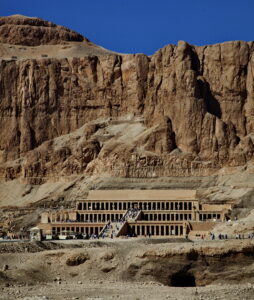
Hatshepsut temple
During her reign, the female pharaoh Hatshepsut (1473–1458 BC) built a mortuary temple at Deir el Bahari, situated directly across the Nile from Karnak Temple, which was the main sanctuary of the god Amun. Djeser-djeseru, “the Holy of Holies,” was designed by the chief steward of Amun, Senenmut. It nestles under towering cliffs, and many find it one of the most beautiful of all the temples constructed in Egypt.
Hatshepsut clearly realized that as a woman in what was usually a male power role, impressive structures that bettered those of previous rulers would help to impress people and legitimize her reign. The temple was modeled after the mortuary temple of Mentuhotep II (2061–2010 BC), who founded the 11th Dynasty. His temple was built during his reign at Deir el-Bahri, and was the first structure there. It was an innovative concept as it was planned to be both a tomb and a temple. Hatshepsut chose a larger interpretation of this temple, positioned next to it, to illustrate her connection to powerful rulers who preceded her and her own power.
Her temple has three levels. On the top level, beyond the portico, is an open courtyard, with statues of Hatshepsut as Osiris, the god of the dead. The temple includes areas for the cults of her father, Thutmose I, the goddess Hathor, and the god Anubis. An altar open to the sky was dedicated to the cult of the solar god RaHorakhty. Hatsepsut claimed as her true father, has a sanctuary dedicated to him at the far end of the upper courtyard, on the temple’s central axis. Painted reliefs on the temple walls depict rituals and religious festivals. Reliefs on the middle platform include Hatshepsut’s expedition to Punt.