ESSENTIAL TO DO BEFORE YOU TRAVEL
Visas
Entry visa requirements vary depending on your nationality. For many visitors a tourist visa can be purchased in advance online on the Egyptian Government Visa website (visa2egypt.gov.eg — see the FAQ “Who requires a visa?”) or on arrival at the airport when you enter Egypt.
Tourist visas are also available on arrival for many nationalities. At Cairo airport the process takes about 20 minutes and costs US$30. The visa is valid for 30 days and can be extended for an additional cost of about US$90.
Other nationalities must obtain their visa before leaving their country. Visas can be obtained at any Egyptian embassy or consulate in your country, but allow enough time before your tour for your visa to be processed. The embassy or consulate in your country should be able to give you an estimate of the processing time.
Shopping Policy
Our guides are not allowed to get commission from shop-owners, and our payment to guides is good so it does not require that they seek extra money from forced shopping. However, should you wish to shop, our guides will take you to some good, reliable and properly priced shops.
Our policy is to be honest and treat our customers as a guest, not as a client.
Before You Travel
Make sure your routine vaccinations are up to date.
Get travel insurance, essential for medical emergencies, and make sure it covers COVID. Also check any medications you need are LEGAL in Egypt.
Email to yourself scans/photographs of your important documents — passport (including the stamped visa page), travel insurance, and both sides of your debit and credit cards. This makes it easy for you to arrange replacement if the originals are lost or damaged. Also email yourself a list of important phone numbers in case of phone loss or damage.
While you will be with your guide for much of the time, there will be times you are on your own. Don’t expect all Egyptians to understand your language. Instead, learn some useful phrases. Even if you have only a few basic phrases, people will appreciate this and make an effort to communicate or help you.
ABOUT EGYPT, THE COUNTRY
Egyptians call the country Misr. It is a Republic and has 27 administrative regions, or governorates.
The Egyptian flag consists of three equal horizontal bands of red (top), white, and black, with the national emblem (a Golden Eagle of Saladin with a shield on its chest above a scroll bearing the name of the country in Arabic) centred in the white band. These band colours are derived from the Arab Liberation flag: black symbolises the eras of oppression, underdevelopment and colonialism; red the bloody struggle to overcome this, or glory; and white is for purity or a bright future.
Geography
Egypt is in North Africa, but because of the Sinai Peninsula we’re also part of Southwest Asia. Egypt covers approximately 1,001,500 square kilometres (386,660 sq mi) — about the same size as all of Central America, twice the size of Spain, four times the size of the United Kingdom, and the combined size of the US states of Texas and California.
Egypt’s coastlines are the Mediterranean Sea and the Red Sea, extending more than 2,900 kilometres. To its west is Libya, to the east the Gaza Strip and Israel, and to the south, Sudan.
Egypt is predominantly desert, with less than 4% of total land area cultivated and permanently settled. The major areas are the Nile River Valley and Delta, the Western and Eastern Deserts, and the Sinai Peninsula. The Nile Valley and Delta support most of the population; the deserts include many oases which contribute to agricultural production.
The Western Desert is more mountainous, and the Sinai Peninsula features a mountain range along the Red Sea coast that includes Egypt’s highest mountain, Jabal Katrinah (Mount Catherine), 2,642 m above sea level. In both deserts, winds create sand dunes that may reach more than 100 feet (30 m) high.
Egypt’s important role in geopolitics stems from its strategic position: as a transcontinental nation, it possesses a land bridge (the Isthmus of Suez) between Africa and Asia, traversed by a navigable waterway (the Suez Canal) that connects the Mediterranean Sea with the Indian Ocean by way of the Red Sea.
The two largest cities are Cairo (population about 22 million) and Alexandria (about 20 million).
Weather
Egypt has a desert climate with hot, dry summers and moderate winters.
Summer temperatures average between 26.7°C and 45°C in Upper Egypt, and up to 43°C on the Red Sea coast. Winter temperatures average between 13°C and 21°C. Wind lowers temperatures near the Mediterranean coast. In spring, the Khamaseen wind blows from the south, bringing sand and dust and sometimes raising the desert temperature to 38°C.
Most rain falls in the winter months. South of Cairo, rainfall averages only around 2–5 mm per year, at intervals of many years. On the northern coast, rainfall can reach 410 mm, mostly between October and March. Snow falls in the Sinai mountains and some northern coastal cities such as Damietta, with rare falls in Alexandria. Desert nights are cold, dropping below zero in winter.
For detailed weather forecasts to help plan your packing, visit Weather.com.
PEOPLE, RELIGION, LANGUAGE AND CULTURE
The population is estimated at 100 million and growing rapidly. About half live in urban areas, including the major cities of Cairo, Alexandria and others along the Nile. Egypt has been continuously inhabited since the 10th millennium BCE, and its history of trade and political takeovers has ensured a rich mixture of genetic and cultural traditions.
Egypt is predominantly Sunni Muslim (an estimated 90%), with 9% Coptic Christian and 1% other denominations.
All Egyptians speak Arabic, and a small percentage speak other languages alongside Arabic, such as the people of Siwa and Nubians.
Egypt is a cultural leader in the Arabic-speaking world, heavily influencing literature, music, film and television with its cultural production.
Egypt offers travel opportunities that span culture, history, adventure, relaxation, family experiences, spirituality, and romance.
Food
The mix of cultures and trade across this country’s history has ensured a wonderful cuisine, with many traditional favourites and contemporary twists reshaping “Egyptian food.” Foods familiar from Middle Eastern and Mediterranean cuisines appear on Egyptian menus.
You can choose from large restaurants, cafes, or street food from small stalls (sometimes on wheels). Meat eaters, vegetarians and vegans can all be satisfied with variety, and while Egyptian food has become part of the offering in many countries through familiar hummus, falafel, and baked sweets, you’re sure to find some new favourites too.
Try: mouloukhiya (dark green soup), koshari, taa’meya (falafel), ful (beans), karkadeh (hibiscus tea, hot or cold), pigeon, and the excellent seafood and BBQ meats. Meals are usually served with soup, salad and/or vegetables, and bread. Food in tourist-area restaurants is naturally more expensive, often comparable to European prices, while places used mostly by Egyptians can be very inexpensive.
Coffee shops are an essential part of Egyptian life, where men gather to drink tea or coffee, smoke shesha, talk, and play board games or watch television. Women do go to coffee shops, but it’s advisable to go with company, not alone.
Hygiene
Be aware that hygiene may not be of the highest standards, depending on the place. A significant number of tourists suffer from some kind of parasite or bacterial infection. Despite assurances to the contrary, exercise common sense and bring appropriate medications to deal with problems.
Drink only bottled water — it’s available everywhere. Local brands (most commonly Baraka, Siwa, Hayat, Dasani) are just as good as more expensive imported options such as Nestlé Pure Life or Evian.
As a precaution, don’t eat raw vegetables or fruits that you can’t peel, and insist that your juice be prepared fresh with bottled water.
For complete, regularly updated travel health information about Egypt, visit mdtravelhealth.com/destinations/africa/egypt.php.
ALCOHOL
Egypt is a majority Muslim country, so alcohol is not served everywhere. It’s available in hotels, bars, nightclubs, pubs, on board Nile cruisers, and in most restaurants. You should not walk around the streets drinking alcohol — restrict your drinking to the places where it is served.
Drinks are available at many hotels, on regular Nile cruises, and at some restaurants and pubs. You are free to order drinks wherever they’re served, but do not drink outside these places, as this could offend conservative local people. You can also drink in the privacy of your accommodation.
Drinking alcohol is part of Western culture. Though about 10% of the Egyptian population are Orthodox Christian Copts and other Christian denominations whose religion permits alcohol, Egyptian society is mainly conservative and does not approve of public drinking. As Muslims constitute the majority of the population, drinking, drugs and other intoxicants are not permissible according to Islamic teachings that encourage sobriety, alert minds and proper social behaviour. For Muslims, it is not permitted by their religion to carry, serve or trade in alcohol, wine, beer and spirits. Although these regulations are not observed by all Muslims in Egypt, please show understanding and patience in cases where serving drinks is not welcomed.
You can buy alcohol at the Duty Free shop on arrival at Cairo International Airport or other international airports in Egypt. You’re allowed to purchase from Duty Free using your passport for 48 hours after arriving, and you’re permitted to bring only 2 litres of alcohol into Egypt.
There are also liquor shops in Egypt, including the “Drinkies” chain, which you can locate using Google Maps. These shops are mainly present in major cities.
If you need to replenish your supply of drinks, especially on board a Dahabiya, ask your guide to arrange for a driver to take you to a local liquor store (for a charge).
Some Dahabiya Nile Sailing staff come from conservative local communities and may not be comfortable serving alcohol, but you can bring your own alcohol on board and use the Dahabiya’s facilities to store your drinks.
FINANCIAL SYSTEM / EXCHANGE
The diverse economy includes tourism, agriculture, industry and services. The unit of currency is the Egyptian Pound (LE) and piaster. The pound is made up of 100 piasters. Coins are 25 piaster, 50 piaster and 1 pound; notes are 1, 5, 10, 20, 50, 100 and 200 pounds. The value of each note is written in English on one side and in Arabic numerals on the other.
Almost all foreign currencies are traded at banks, exchange offices, airports, and major hotels in Egypt at the official currency rate (Scottish and Northern Ireland banknotes are not accepted). ATMs are widely available. Most banks are open 9am–2pm, Sunday to Thursday, with some branches open until 5pm. Hotel branches in some cities operate 24 hours.
USD and Euro are normally accepted in touristy restaurants, cafes and shops, as are credit cards, but local places generally accept only EGP.
You can change money at the airport bank when you arrive — the rate is fixed across the country. Don’t change too much, as it’s difficult to change EGP back into USD or Euro. Every city you visit has an exchange office, and your guide can help with this too.
For updates on exchange rates, visit the Egypt National Bank website (nbe.com.eg/en/exchangerate.aspx).
Credit and debit cards — American Express, Diners Club, MasterCard and Visa — are accepted in touristic places and shopping malls, but cash is more commonly used in Egypt.
International travellers’ cheques in Sterling, Euro and US Dollars are accepted in a few places in major cities, with about a 3% commission charged for use.
Note: in some smaller towns there is only one bank and one ATM, credit cards are not accepted everywhere, and bank opening hours are more limited than in many other countries. It’s advisable to always carry enough cash and small change for small purchases including food and water.
PHONES AND INTERNET
You can roam with your international number by registering on any of Egypt’s three mobile operator networks — Vodafone, Orange or Etisalat. Alternatively, it’s inexpensive to buy a local SIM card on arrival if your phone is unlocked. These can be topped up easily with a scratch card, available at many stores besides mobile supplier outlets.
Landlines are available in all hotels. Wireless internet is available in many hotels, restaurants and coffee shops — sometimes free, sometimes charged.
Internet connection is no longer a problem in Egypt (unless you’re in far-out places like the mountains), with mobile network coverage across almost all of the country. You can get connected using a local SIM with a data plan and use your smartphone as a hotspot. Data plans are inexpensive in Egypt.
EGYPTIAN AIRPORT AND PORT AUTHORITY CUSTOMS
You are not allowed to import more than 200 cigarettes (or 25 cigars, or 200 grams of tobacco) and 1 litre of alcohol. Passengers on flights may not carry flammable liquids, mercury, or liquid and dry batteries; electronic devices containing lithium (computers, cameras, car batteries, lighting systems) are also restricted, except for private mobile phones. Frozen items and liquids exceeding 100ml are not permitted in baggage, except items bought duty-free inside the airport (sealed, with receipt).
It is illegal to bring in drugs, firearms and other weapons (including Swiss Army knives), or seeds and agricultural seedlings (to prevent the transfer of pests).
Drones can only be brought in with an official licence, which is difficult to obtain.
Please check before you travel that any medications you use are LEGAL in Egypt. It is illegal to export drugs, firearms, and cotton that isn’t for personal use. Locally purchased gold and silver can be exported if for personal use or in small quantities.
Egypt strictly controls the import and export of antiquities and artefacts more than 100 years old — you’ll need a licence to export any such item.
You can bring in up to US$10,000 (or the equivalent in other foreign currencies) for exchange, plus up to 5,000 Egyptian pounds in local currency. Leaving Egypt, the maximum allowed for foreign exchange is also US$10,000.
Camera Charges
At some monuments there’s an additional charge to use a camera. At some sites, photography — and use of a flash — is completely forbidden. Your guide will advise you, and camera tickets can be bought at sites when required. Any commercial photography or video needs official permission in advance; using tripods or camera stabilisers is often considered a sign of commercial use.
DRESS CODE AND CULTURALLY APPROPRIATE BEHAVIOUR
Egyptian society is conservative, in some places more than others. Exposed arms and legs are accepted in big-city nightclubs and tourist hotels in places like Sharm el Sheikh and Hurghada. However, off the beaches and in the streets, you’ll be mixing with Egyptians who mostly choose modest dress for religious and traditional reasons. You’ll be more comfortable — and have the chance for deeper interactions with Egyptians — if you dress modestly. This applies to men too: many Egyptian men cover their arms and don’t wear shorts that expose above the knee.
The Basis of Your Travel Wardrobe
Men: long pants and shirts.
Women: long pants and skirts combined with a longer shirt (covering the upper thighs) that is loose, long-sleeved, and doesn’t show cleavage.
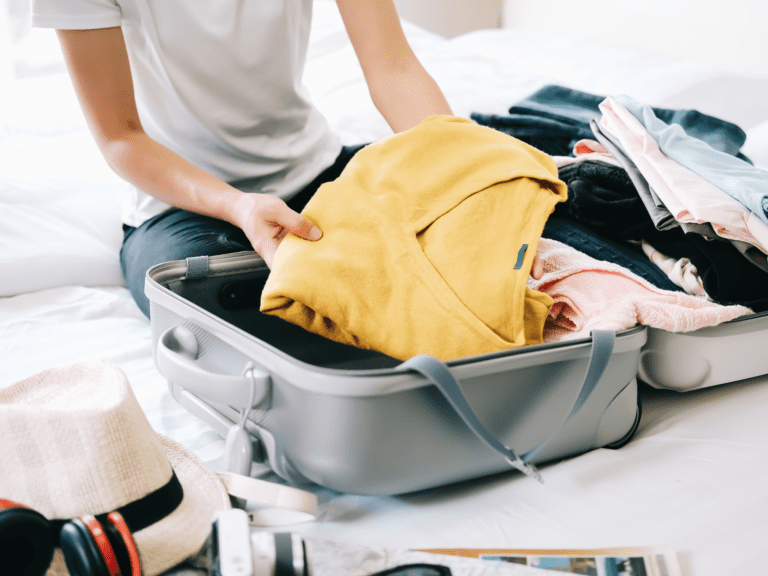
Choose clothing made of natural fibres — cotton, silk, hemp, linen, or a mix. White or light colours reflect heat, while darker colours will make you feel it more. For women especially, long, loose layers can be just as comfortable as shorts and a tank top, with the bonus of not needing sunscreen for the skin you’re covering.
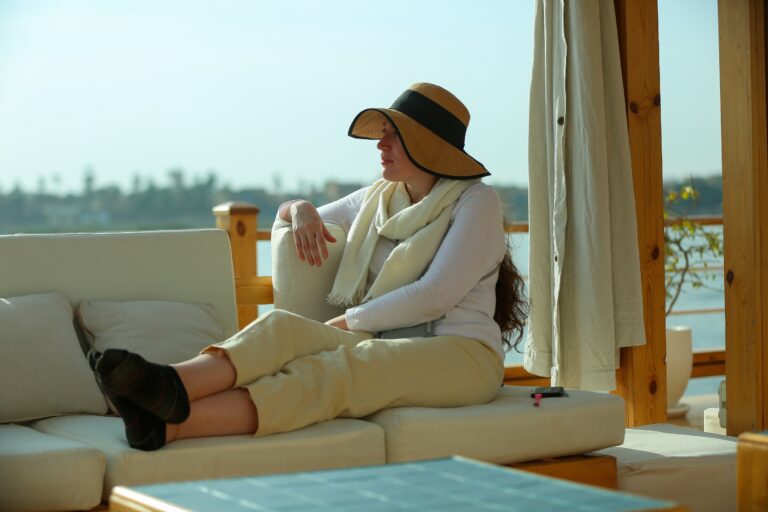
Women should carry a large scarf to cover hair and shoulders when entering mosques. Some mosques provide an abaya, a loose garment covering you from head to feet. Some Christian women cover their hair in church, so bring a scarf if attending a service. A scarf can also help you feel more comfortable in more traditional areas — your guide can advise — and it protects you from sun and sand dust too.
You’ll see Egyptian women wearing different levels of cover, from dressing similarly to you, to being covered completely except for their eyes. Look beyond any apprehensions or assumptions based on appearance — the women behind the covers have much to offer if you make conversation. They’re often curious (and maybe a little bewildered) about you and your life too. Bedouin women and the women of Siwa Oasis cover more than most; you’ll be more accepted in these places if modestly dressed.
Wear a hat to protect from heat and to prevent your hair and scalp from burning — light-coloured, broad-brimmed, with an adjustable string is best (there’s often a breeze).
If swimming in a conservative place, such as natural springs in the oases or local beaches, shorts or leggings and a shirt are best.
Comfortable shoes are essential. Socks are also advised, even in summer, as they protect against mosquitoes in the evenings.
Always pack an extra layer of clothing — early morning winter tours anywhere in the country, and desert nights, can be very cold. Temperatures in some places can drop 20 degrees from the daytime peak to the nighttime minimum.
Choose sunglasses that protect from UV radiation, and don’t look directly at the sun.
INDOOR AND EATING ETIQUETTE
Shoes must be removed before entering a mosque. People also go shoeless in many homes and eating places, especially where you’ll be seated on the floor — watch what others do and take your cue from this. If sharing a traditional Egyptian meal from the same bowls and eating with bread, note that people eat with their right hand, even if left-handed. When eating with bread, use small portions and try to eat each portion in one mouthful.
GREETING PEOPLE, PUBLIC INTERACTION
Showing affection is different here. Do not kiss or embrace someone of the opposite sex in public. You’ll see Egyptian couples holding hands in cities, but these will be married, engaged or courting couples. Children are freely embraced and kissed in most places — they’re adored here — but as a foreigner, don’t kiss or embrace a child unless you know them and they initiate it. Smiles and waving are fine.
Many women don’t like to be photographed, and children in some places will object too — always ask first, and ask a parent’s permission if present. Many, however, will happily pose for photos, and children (and adults) may ask to have their photo taken with you.
Handshakes are an accepted greeting for foreigners, but be aware some Muslim women don’t shake hands, and some Muslim men won’t shake hands with women — don’t feel slighted if this happens. Foreigners shouldn’t greet those of the opposite sex by kissing or embracing. Men often walk arm in arm or with an arm around a friend’s shoulder — this is purely a gesture of friendship here, not indicative of sexual preference. Men embrace each other warmly and kiss lightly on meeting; women may also greet each other with a kiss.
Egyptian body language is its own complex world. Avoid maintaining eye contact for a long time — women especially, as it can be misread as staring, rudeness, a challenge, or even an unintended invitation to intimacy.
In tourist resorts, you may meet Egyptian men who use Western social body-contact norms, like touching your arm or trying to hold your hand. It’s best to politely decline this contact, as it only encourages inappropriate behaviour and makes things harder for other women visitors and for Egyptian women who don’t welcome this level of intimacy.
HEALTH AND WELLBEING
How to avoid dehydration, heat stroke and heat rash, and maintain your energy to really enjoy your travel:
When possible, schedule activities so you’re in shade or air-conditioning during the hottest times — follow local business hours and living patterns, which are often set to avoid the heat.
Drink more water than usual, especially since you may be more physically active on holiday than at home. Alcoholic drinks and caffeine (tea, coffee, some soft drinks) dehydrate you, so limit these. Avoid heavy meals and favour cooler, high-water-content foods like peelable fruit. This doesn’t mean skipping local coffees, teas and delicious food — just don’t overdo it. Rehydration sachets are a handy asset.
Take cool showers rather than hot ones. If outdoors and feeling the heat, soak a cotton scarf in water and tie it around your neck.
Aloe vera relieves sunburn, heat rash and other skin irritations; cold tea also soothes sunburn. Natural cornstarch powder (without talcum chemicals) can ease skin problems, and a few drops of peppermint oil in water or a natural moisturiser is great for aching feet and legs.
If the heat gets too much, ask your guide to stop for a cool lemon juice made with bottled water — and enjoy the fact that you’re seeing blue skies and amazing sights while people back home may be dealing with cold, grey weather.
Medication and Prescription Glasses/Lenses
Bring your preferred mosquito deterrent — spray, cream, or deterrent arm bands.
Bring your prescription medicine, but always check with the Egyptian embassy or consulate beforehand to confirm what medicines are legal to bring into Egypt, as laws differ from country to country. A doctor’s note listing your medications is helpful. Bring Imodium or another anti-diarrhoeal and keep it in your bag — most people don’t get sick, but even a change in water can cause diarrhoea.
Email yourself, or upload online, a copy of each prescription, including for glasses or contact lenses.
Do not drink tap water — use bottled water for brushing teeth too.
OTHER THINGS TO PACK
– Torch — small, useful in many ancient monuments (and in case of electricity failures)
– Sunscreen (high factor) — you’ll be exploring for many hours, and even in winter fair skin may burn
– A mosquito net, if you react badly to bites — light and compact, and preferable to nightly chemical sprays if travelling more than a week, especially along the Nile Valley. Once there, lemons rubbed on bites or a piece of dry soap can ease the itch, safely
– A lightweight extra bag that folds into your main bag, for things you buy and bring home
– Small gifts for children (rather than money) — an inexpensive item representing your home country works well
– Depending on your interests — bird watching, fossil hunting, astronomy — you may want binoculars, a magnifying glass, or a constellation map for stargazing
ELECTRICAL APPLIANCES — CONVERTERS AND ADAPTORS
Voltage is 220–240 volts, with a 2-pin plug. You’ll need a converter for any appliance that doesn’t match this. Electric sockets are one of two European standard types: “Type C” Europlug or “Type E”/”Type F” Schuko. If your appliance plug doesn’t match, bring a travel plug adapter — buy this before you arrive, as you don’t want to waste holiday time finding a supplier.
BARGAINING
Bargaining is part of life here, and it takes practice and patience to get “local” prices. Decide what you’re really willing to pay for an item, and approach bargaining in the spirit of a game, not a challenge to beat the seller down to their absolute minimum. Consider the labour and skill involved in producing an item — don’t expect something for nothing. If you go too low, the seller will rightly refuse; there’s no point getting angry, as they have a living and business overheads to cover, just like sellers anywhere.
That said, you can find genuinely great bargains in Egypt — wonderful crafts by skilled artisans, perfect as memories or gifts. Shopping often includes tea or a cold drink with the seller, and negotiations take time. Carry small change, as many shops may need to go get change for you.
Our tour guide is ready to help and give suggestions about this.
TIPPING EXPLAINED AND SUGGESTIONS
Tipping is generally expected in Egyptian culture, but should only be given if the service is excellent.
To ensure your tour goes smoothly, we cover some tipping on your behalf as part of our service (restaurants, guards, short boat rides, horse carriages, local guardians, luggage handling in the hotels we book, etc.). Tipping is not compulsory.
Gratuity Guidelines (per person per service, in EUR — suggestions, not compulsory)
Airport Assists / Driver per day tour: EUR 4–6 per person per day
Guide: EUR 9–13 per guest per day
Camel or Horse ride: EUR 2 per person per ride
Felucca or motor boat ride (1–2 hours): EUR 1–2 per person per ride (depends on number of guests on board)
Dahabiya Crew Tipping (suggestions, not compulsory)
EUR 13–17 per person per night
3 nights: EUR 38–51 per person per trip
4 nights: EUR 61–68 per person per trip
Note: the fewer people on board, the higher the per-person rate expected.
Covers all staff (12–14 crew members) — Captain, Chef, Waiter, Housekeeping, Sailors, Tug Boat Driver, etc. Does not include the tour guide.
Best given in an envelope on the last night after dinner, to the boat captain (the night before checkout).
Nile Cruise Crew Tipping (suggestions, not compulsory)
EUR 9 per person per night
3 nights: EUR 26 per person per trip
4 nights: EUR 34 per person per trip
Does not include the tour guide.
Overnight Felucca Crew Tipping (suggestions, not compulsory)
EUR 4–9 per person per day
Note: the fewer people on board, the higher the per-person rate expected.
Does not include the tour guide.
THINGS NOT TO DO IN EGYPT
– Photograph restricted sites, such as military sites, or anywhere an official indicates you should put the camera away
– Photograph women and children in some places without checking with your guide first
– Carry any weapons, including Swiss Army knives — these are banned in Egypt
– Go anywhere without your passport or other identification
– Drink and dive — this increases your risk of decompression sickness
– Take anything from national parks or antiquity sites
– Stand on, climb on, lean against, or rest feet or bags on walls, or touch artwork (including statues) at monuments or museums — respect Egyptian and world heritage for future generations
– Kiss and/or fondle your partner in public
– Discuss Egyptian politics with people you don’t fully trust