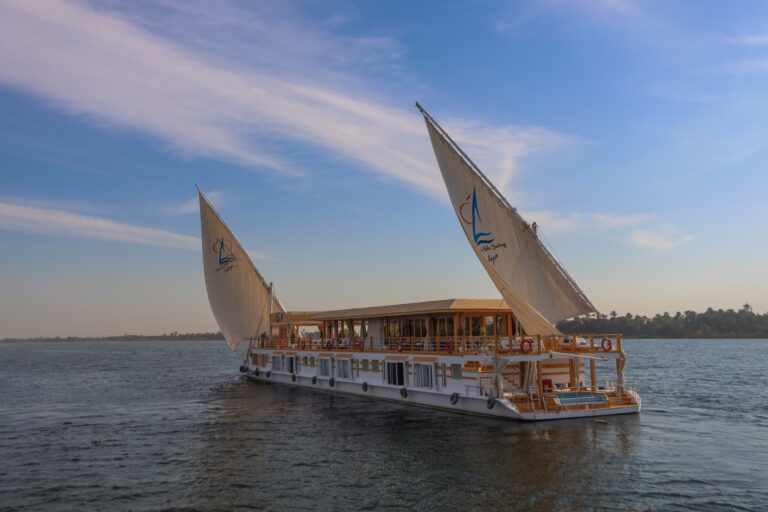
Egypt and the Nile have been an inspiration for many writers. Among those who have written about their experiences are many women, perhaps initially interested in seeing the ancient Egyptian temples and tombs but who also brought readers fascinating details of life in Egypt during the times they visited or lived here.
“One wonders that people come back from Egypt and live lives as they did before”
Florence Nightingale
Travel for women in the 1800s and early 1900s was an escape, at least briefly, from demands and expectations of their society, while also giving them exposure to cultures substantially different from their own.
Women traveling often experienced and viewed their surroundings and the people they encountered differently to the ways in which male travelers moved through a country or city and perceived it. Women travelers had (and still have) the potential to gain and give readers unique insights, especially as they sometimes had access to places men did not.
Although the societies they came from were slowly changing, many women still had limited self-determination or opportunities to express themselves and their ideas. In writing about Egypt and its impact on them, they were more freely able to give their views on many subjects.
This led to some changing their lives substantially following their time in Egypt. Their travel experiences expanded their horizons not only in a physical sense but contributed to their mental and spiritual growth.
Carl Thompson is accurate in his view that “If the female traveler contravenes the patriarchal ideology of separate spheres by quitting her home and venturing out into the world, the female travel writer, or at least, the woman who publishes a travel account, contravenes that ideology twice over.”
However empowering their experiences, their writings can also tell us much about their negative attitudes and prejudices. Many travelers came to Egypt with Orientalist fantasies which the real Egypt didn’t always fit, and their reports were often judgemental. While some questioned the assumptions and stereotypes they and their societies held about Egypt and its people, it seems some found it too challenging to understand or accept the ways of life they observed. Some of their prejudices were connected to Empire and the idea that the West was civilized and enlightened while the East was primitive or even savage.
Many travelers brought with them stereotypes and generalizations that fit or embellished long established Orientalist views regarding women in Egypt. The ability of women travelers to meet local women, although better than the opportunities for male travelers, was sometimes still hampered by the Egyptian women being shy or secluded. In addition, some writers could only share a subjective view of women and hareems because of their own social or religious backgrounds. Although they were writing to give information, they were perhaps cautious not to offend the sensibilities of their readers. Objective views were perhaps also less possible because their perspectives on the lives of the local women may not have taken into account the role of women in a Muslim society.
Many travelers viewed people as part of the grand display of Egypt they were passing through, not as real people. Often visitors were more interested in the ancient monuments than in the people. Some who started out as critical of Egyptian ways of living and behaviors changed their minds as they had more exposure and came to understand that there were other ways of living and thinking. Some writers were more aware of a need to look beyond their own frame of reference, for example Harriet Martineau was not impressed by large numbers of mummified animals but felt that “we ought to understand before we despise, and that, usually, the more we understand the less we despise”.
There were also prejudices expressed about the form of travel chosen to experience Egypt, Thomas Cook introduced a new, packaged way of touring the Nile, on steamers that isolated the tourists more from the country they were passing through and from its people.
This was viewed with contempt by those who had the money and time to tour on a private boat, which was considered a more romantic way of seeing the country. As Carl Thompson commented, “Another recurrent feature of many Victorian travelogues, accordingly, is an anti-touristic rhetoric that seeks to distinguish the author from the more vulgar tourist ‘herd’.”
The women writers we will present travelled and lived in Egypt in different ways and for different reasons so it is natural their reports differ, although they also have many commonalities.
For example, Sophia Lane Poole and Lucie Duff Gordon lived in Egypt for several years and had more opportunity to study and begin to understand the local people, and although they ultimately remained cultural outsiders they were able to provide some balance to the publications by short term visitors.
Some visited purely as tourists, including Florence Nightingale and Maria Georgina Shirreff Grey, but their observations still had worth despite their views being less flexible. Their writing sometimes reveals as much of their personal biases and those of their own societies as it reveals about Egypt. Sherriff Grey apparently remained unmoved by much of what she saw. Nightingale’s attitudes about Egypt improved during her tour, although the change was more in her opinions on the monuments of the past than in her responses to the people of her present.
The visits of Harriet Martineau and Amelia Edwards were nearly 30 years apart, both were independent writers and determined women who were interested in more than merely presenting a travel tale. Egypt in different ways changed their lives and determined their courses long after their tours.
In the next century writers such as Agatha Christie and Elizabeth Peters brought us imaginative novels infused with the growing knowledge about Egypt.
Travel writing brings us differing views of a country, perspectives that were determined not only by the reality of what was seen and experienced but perhaps determined as much by the culture of the writers and the culture of the reader. These books should be enjoyed with this in mind.
On a positive note, reading a selection of these writers it becomes evident that the views and prejudices of these women were sometimes transformed by their experiences.
Although European travel writing was often “a vehicle for the expression of Eurocentric conceit or racist intolerance”, fortunately some writers did manage “to overcome cultural distance through a protracted act of understanding”. (quote from Dennis Porter, Haunted Journeys: Desire and Transgression in European Travel Writing (Princeton University Press, 1991).
Following is a sample of the many books written by women about or drawing inspiration from their time in Egypt.
You will find more suggested reading on our Pinterest board where we regularly add more books and magazines on a wide range of Egypt related subjects https://www.pinterest.com/realegypt/books-about-egypt/
BOOKS and WRITERS
The Englishwoman in Egypt: Letters from Cairo, written during a residence there in 1842 – Sophia Lane Poole
Sophia Lane Poole traveled to Egypt in 1842 and stayed for many years. Her aim was to research and publish about Egyptian women and their customs. Her work was to provide more female insights in line with that of her brother Edward William Lane’s Manners and Customs of the Modern Egyptians. She learnt Arabic and dressed in local style, this and her research intentions made her access to hareems more productive than the visits of other women writers.
Eastern Life, Present and Past – Harriet Martineau (1848)
Martineau was perhaps the first female sociologist. The death of her father led to financial difficulties for her family, she contributed income by writing novels, histories, travel books, translations, political and social publications. Martineau did not shy from expressing controversial views, supporting the abolition of slavery and rights of women to education and self-development, and when she traveled to Egypt she was already an experienced writer on economic, political and educational issues.
She traveled with friends in 1846-1847, for eight months from Cairo down through Nubia by boat, horse, donkey, camel and on foot. She also traveled to Palestine and Syria.
Back in England she published Eastern Life, Present and Past which includes the trip from Cairo to Assuit, Luxor, Edfu and Aswan up until the second Cataract. Her focus was on history, religion and the customs of the people around her.
Joan Rees stated “the greatest value of Eastern Life rests in her vigorous and imaginative attempts to prise open closed minds so that they might catch at least a glimpse of wider horizons than conventional English education had prepared them for.”
Letters from Egypt, A Journey on the Nile, 1849-1850 – Florence Nightingale (published 1987)
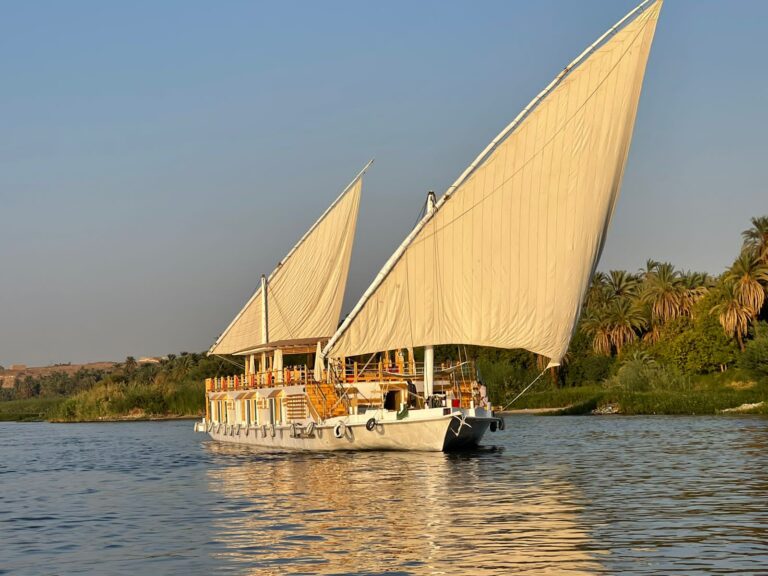
Some years before she became known as a symbol of modern nursing, in the winter of 1849 Florence Nightingale (age 29) traveled to Egypt. She believed she had a calling and had refused marriage, so her parents sent her on a trip through Europe with some friends. This led to Egypt and a dahabiyah trip up the Nile.
She kept a private journal and also wrote letters to family and friends. Some of these letters were edited by her sister in 1854, but it was not until 1987 that Anthony Sattin found, selected and published her letters as a book.
Journal of a visit to Egypt, Constantinople, the Crimea, Greece, &c: in the suite of the Prince and Princess of Wales, 1870 – Maria Georgina Shirreff Grey
Shirreff Grey traveled in Europe early in her life and was a skilled linguist. With her sister Emily she outlined an education for girls which included subjects such as arithmetic, geometry, history, elementary science and politics. She wrote during her marriage, but her public advocacy for improving education for girls increased after her husband’s death in 1864.
In 1869 she traveled to Egypt with the Prince and Princess of Wales. The Viceroy lent them his boat to travel up the Nile and arranged entertainment for them. This was around the time of the opening of the Suez Canal and the launch of the first Thomas Cook steamer, so Shirreff Grey documents a privileged view of a moment when Egyptian tourism and Nile travel were about to change substantially.
Her diary mostly described the daily activities of the royal tour party, with less enthusiasm for the ancient Egyptian monuments. Although she visited several hareems and experienced elite society she did not comment in any depth on the lives of the women, only on appearances and food. She did not write intending to publish, but her brother-in-law had her work printed.
A Thousand Miles up the Nile – Amelia Edwards (1876, second edition 1888)
Edwards was an established writer with several successful novels. She traveled in Europe and her account of hiking in the Dolomites during 1872, Untrodden Peaks and Unfrequented Valleys, was well received.
In 1873 she traveled with a friend to Egypt and they hired a dahabiya and crew for the Nile trip from Cairo to Abu Simbel and back. Edwards became increasingly fascinated by the ancient monuments and this was to prove significant for the rest of her life and for Egyptology.
Returning to England, in 1876 she published A Thousand Miles up the Nile which included her illustrations made throughout the trip, and this travel account was a great success.
Edwards took her research seriously, learnt to read hieroglyphs and corresponded with Egyptologists such as Gaston Maspero and Dr. Samuel Birch, Keeper of Oriental Antiquities at the British Museum. She was concerned about the preservation of ancient Egyptian monuments and became an advocate for this.
In 1882, she co-founded the Egypt Exploration Fund (now Society) with Reginald Stuart Poole (a son of Sophia Lane Poole, a writer you have already met above). She bequeathed her collection of Egyptian antiquities and her library to University College London, with funds to found an Edwards Chair of Egyptology.
Her trip up the Nile turned into far more than a popular travel tale, it made Egypt her passion for the rest of her life and her work benefited the careers of many including Edouard Naville, Flinders Petrie and Francis Llewellyn Griffith.
Letters from Egypt, 1863-65 and Last Letters from Egypt – Lucie Duff Gordan (1866 and 2010)
Duff Gordan lived in Luxor for many years, in “the French house” set in Luxor Temple which was lent to her by the French Consul (Belzoni and Champollion, significant contributors to early Egyptology, had stayed there before her). Her letters included details about her everyday interactions with Egyptians and observations on the country and society, with many fascinating insights to local life.
She spoke several languages and before settling in Egypt had translated many literary works. In England her home circle of visitors had included Dickens, Thackeray, Warburton, Tennyson and other luminaries. Yet after some time in Egypt she would note “When I go and sit with the English, I feel almost as if they were foreigners to me too, – so completely am I now “Bint el-Beled” (daughter of the country).”
Duff Gordan wrote the most humane account of Egyptians, she was compassionate and positive in her aim of understanding those she lived among. Although she had come to Egypt with severe tuberculosis (eventually fatal), she made efforts to help others and her care gained the affection of many local people.
Her writing covered many subjects and provided many insights, however she admitted in one of her last letters to her husband a regret that she had not written more about what she had learned: “I honestly believe that knowledge will die with me which few others possess. You must recollect that the learned know books, and I know men, and what is more difficult, women.”
Wayfarers in the Libyan Desert – Lady Evelyn Cobbold (1912)
Early in the 1900s two women traveled through the north of Egypt. Not much is known about American Frances Gordon Alexander (née Paddock), but Lady Evelyn Cobbold, daughter of a Scottish earl, later became the first British-born Muslim woman to perform the hajj (pilgrimage) to Mecca. They traveled from Cairo into the Libyan Desert and to Fayoum Oasis, guided by and with assistance of Egyptians.
Wayfarers in the Libyan Desert documented their experiences. It includes enthusiastic descriptions of visits to sites that will be familiar to anyone interested in Egyptology, for example their visit to the tomb of Ti:
“As we descend into the mysterious silence of the tomb, the Arab guardian lights candles whose feeble rays enable us to see dimly the marvelous drawings on the walls, in those rooms unlighted from above…In the exquisite bas-reliefs which cover the seven rooms of his mastaba there is such restraint, sense of proportion; above all such delicate modeling, such perfect rendering of every animal, bird, and reptile, that each one is at once an individual portrait and a type.”
During her childhood Cobbold spent winters in Algiers, she had some familiarity with Islam and the life of the people in this region, an interest which grew over the years. She renamed herself Lady Zainab and at age 66 made the pilgrimage to Mecca, published as Pilgrimage to Mecca (1934).
Moving further into the 20th century we find more novels than book travelogs inspired by Egypt. This could be due to the rise in television documentaries and series which took over from books in presenting the “this is what we saw and did” of travel experiences.
Into the 21st century novels inspired by Egypt continue to be published, while travelogs have morphed into blogs and vlogs as the popular ways to document travels through Egypt.
Naturally there are also many excellent novels about Egypt by Egyptian women writers, but that is another blog to look forward to.
Death on the Nile – Agatha Christie (1937) The great detective Hercule Poirot is on holiday in Egypt, but not for long…One of the best known novels set in Egypt, a classic murder mystery that has been reinterpreted in several movies. Christie had a passionate interest in Egypt and it was the setting for several of her novels, more details at https://www.smithsonianmag.com/history/how-agatha-christies-love-of-archaeology-influenced-death-on-the-nile-180979544/
Visitors today sometimes like to stay at the Cataract Hotel in Aswan where Christie stayed. This hotel was also the setting for the excellent Egyptian television series “Secrets of the Nile / Grand Hotel”, a murder mystery, but we will discuss that in another blog post.
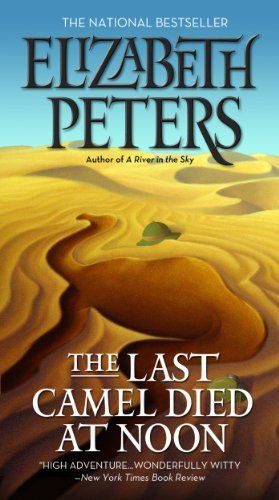
The Amelia Peabody series – Barbara Mertz under the name Elizabeth Peters (1975–2010, 2017)
“Another dead body. Every year it is the same. Every year, another dead body…”
Abdullah in Lion in the Valley.
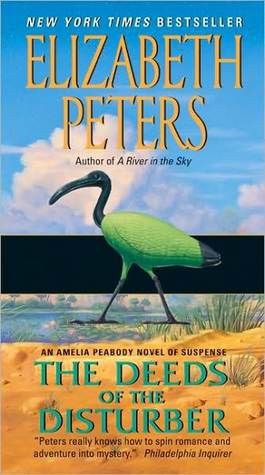
The series of novels featuring the character Amelia Peabody has become one of the most loved fictions set in Egypt and has undoubtedly inspired many to visit or at least dream of visiting.
The series was written by Barbara Mertz under the name Elizabeth Peters. Mertz received her PhD in Egyptology at the University of Chicago in 1952. Her novels overflow with references to ancient Egypt as her characters visit many of the ancient sites, and give vivid descriptions of traveling along the Nile. She also included some astute criticism of colonialism and the attitudes of European explorers in the series, the events of which take place 1884 to 1922. Each book can be read as a stand-alone without previous knowledge, however the characters age throughout the series and events in earlier books (including spoilers concerning some of the main characters) are referenced in later books.
Mertz also published two non-fiction books about ancient Egypt.
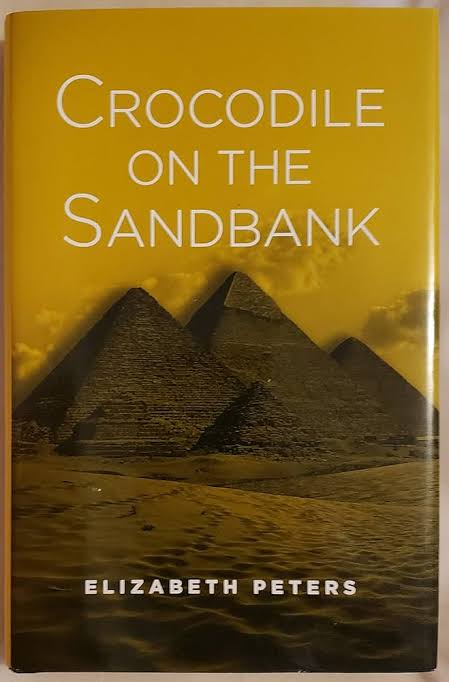
If you haven’t read the Amelia Peabody series, start with “Crocodile on the Sandbank” which introduces key characters and gives you a taste of the sense of adventure, mystery (and a touch of romance) that features in the series. English scholar Amelia Peabody inherits a fortune from her father and leaves England to explore. In Rome she meets Evelyn Barton-Forbes, a young Englishwoman of social standing who had run off with and been abandoned by her Italian lover. The women travel to Egypt where they meet the Emerson brothers: the Egyptologist
Radcliffe and the philologist Walter. As they travel they become romantically involved, Amelia marries Radcliffe (referred to throughout the series by his last name “Emerson”), and Evelyn marries Walter.
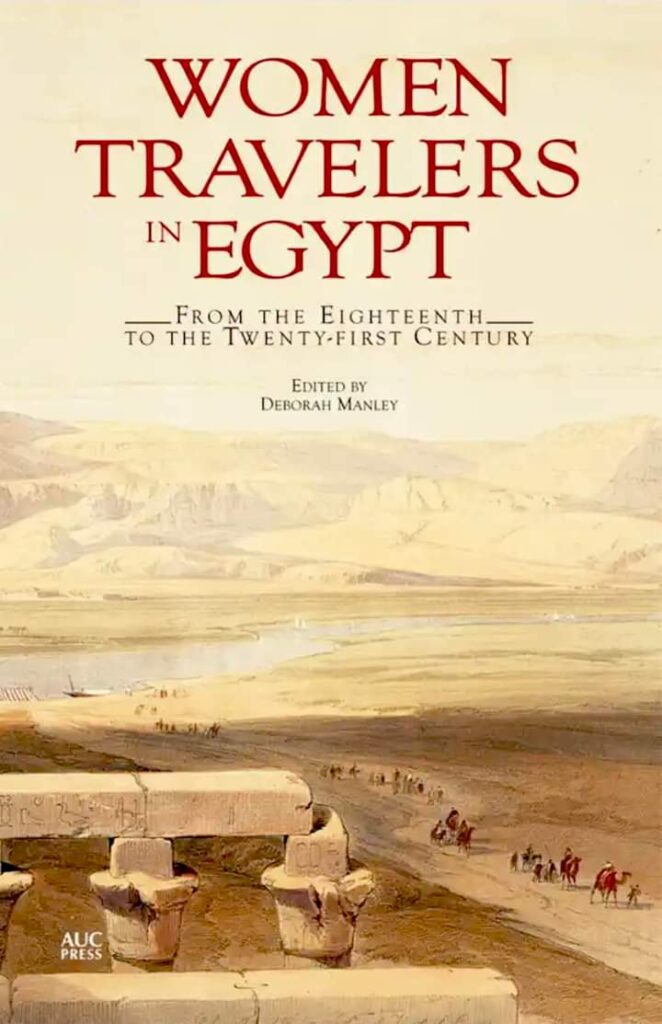
Women Travelers in Egypt: From the Eighteenth to the Twenty-first Century (2013) edited by Deborah Manley features more than 40 women who explored Egypt.
“Until late in the nineteenth century, few guide books acknowledged the presence of women as travelers – although women had been traveling around the world for centuries. Women’s accounts of their journeys, distinct from those of male travelers, began to appear more frequently in the early nineteenth century, and Egypt was a popular destination.
Women had more time to watch and describe and they spent time both in the harems of Cairo and with the women they met along the Nile. Some of them, like Sarah Belzoni, Sophia Poole, and Ellen Chennells, spoke Arabic. Others wrote engagingly of their experiences as observers of an exotic culture, with special access to some places no man could ever go.
From Eliza Fay‘s description of arriving in Egypt in 1779 to Rosemary Mahoney’s daring trip down the Nile in a rowboat in 2006, this lively collection of writing by over forty women travelers includes Lady Evelyn Cobbold, Isabella Bird, Winifred Blackman, Norma Lorimer, Harriet Martineau, Florence Nightingale, Amelia Edwards, and Lucie Duff Gordon.”
(from the publisher AUC Press)
Books about traveling or living in Egypt by some of the women mentioned above, and commentaries on their writing and lives.
Duff Gordon, Lucie. Letters from Egypt, 1863-65. Edited by Sarah Austin. 1865. British Library, Historical Print Editions, 2011. Original edition: Macmillan, 1866.
Duff Gordon, Lucie. Last Letters from Egypt: To Which are Added Letters from the Cape. Cambridge University Press: 2010.
Edwards, Amelia B. A Thousand Miles up the Nile. 1888. Parkway Publishing 1993. Original edition: George Routledge and Sons, 1891.
Grey, Maria Georgina Shirreff. Journal of a visit to Egypt, Constantinople, the Crimea, Greece, &c: in the suite of the Prince and Princess of Wales. 1870. Forgotten Books, Classic Reprint Series, 2012. Original edition: Harper, 1870.
Lane Poole, Sophia. Lane, Edward William. The Englishwoman in Egypt: Letters from Cairo, written during a residence there in 1842. 1845. Vol. 1 of 2. Forgotten Books, Classic Reprint Series, 2012. Original edition: C. Knight, 1844.
Martineau, Harriet. Eastern Life, Present and Past. 1848. Vol. II. Bibliolife, 2012. Original edition: Lea and Blanchard, 1848.
Nightingale, Florence. Letters from Egypt, A Journey on the Nile, 1849-1850. Selected and introduced by Anthony Sattin. Weidenfeld & Nicolson, 1988.
Cobbold, Lady Evelyn. Wayfarers in the Libyan Desert. A. L. Humphreys, 1912.
Rees, Joan. Women on the Nile Writings of Harriet Martineau, Florence Nightingale and Amelia
Edwards. Stacey International, 2008.
Frank, Katherine. A Passage to Egypt The Life of Lucie Duff Gordon. Houghton Mifflin Company, 1994.
Karara, Azza. Sophia Lane Poole, The English Woman in Egypt : Letters from Cairo written during a residence there in 1842-46. AUC Press, 2003.
Logan, Deborah. Harriet Martineau, Victorian Imperialism, and the Civilizing Mission. Ashgate Publishing Limited, 2009.
Martineau, Harriet. Harriet Martineau’s Autobiography. Forgotten Books, Classic Reprint Series, 2012
Pichanik, Valerie. Harriet Martineau. Michigan University Press, 1980.
Sattin, Anthony. A Winter on the Nile, Florence Nightingale, Gustave Flaubert and the Temptations of Egypt. Windmill Books, 2011.
Manley, Deborah (editor). Women Travelers in Egypt: From the Eighteenth to the Twenty-first Century. AUC Press, 2013. https://aucpress.com/9781617973604/
Manley, Deborah (editor). A Nile Anthology, Travel Writing through the Centuries. AUC Press, 2015.
Christie, Agatha. Death on the Nile. Collins Crime Club, 1937.
https://www.agathachristie.com/en/stories/death-on-the-nile
Peters, Elizabeth (Barbara Mertz). The Amelia Peabody series is listed at https://en.wikipedia.org/wiki/Amelia_Peabody_series
Thompson, Carl. Travel Writing. Routledge, 2011.
Porter, Dennis. Haunted Journeys: Desire and Transgression in European Travel Writing Princeton University Press, 1991.
ADD under the appropriate images these captions:
Barbara Mertz. AP Photo/HarperCollins
Death on the Nile by Agatha Christie – dust-jacket illustration of the first UK edition 1937.